
A haunting journey to a night in Greenland, where I watched a tribe’s last hope vanish.
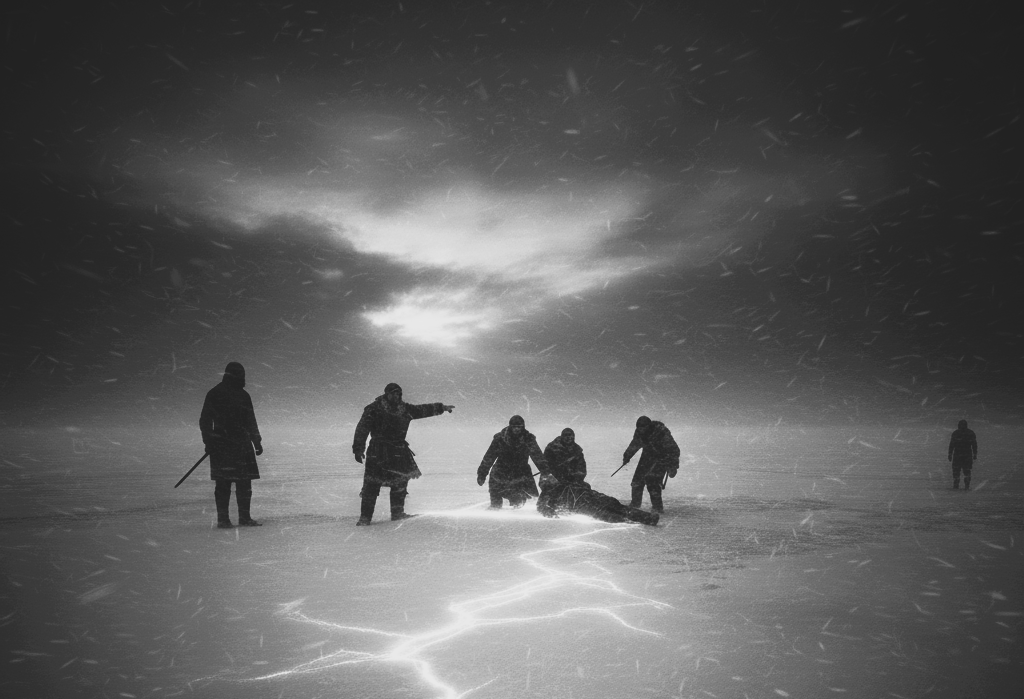
Last night, I was wandering on icy landscapes of Greenland alongside my six characters. It was a harrowing night of 1302 A.D. The snowfall was so heavy that everything was a blur, but as I gazed through the storm, I saw them: six figures. They were the skilled hunters of the Dorset tribe.
The blizzard was terrifying. Biting winds whipped the snow against their faces like sharp needles piercing their skin. Night had fallen, and these hunters were far away from their homes – so far that they had been walking since dawn.
To search for prey in such a storm was nothing short of madness, yet the lead hunter’s stubbornness had forced them all onto this treacherous expedition.
The darkness of night, fury of the blizzard, and above all, the exhaustion of the journey were now insurmountable hurdles. Their feet felt heavy; every step into the deep snow felt like a struggle to lift lead. It was as if heavy iron chains were fastened to their ankles.
Finally, one of the hunters fell on his face into the snow. His heart pounded and his breath came in violent gasps, his eyes fluttering as he drifted into unconsciousness. The others rushed to his side, but the lead hunter merely turned his head, remaining where he stood.
“Pick him up … We cannot stop.” His voice was cold and hard.
The other hunters snapped back, “He can’t stand. He’s gone unconscious!”
The lead hunter growled, “Then leave him. Someone stay with him if you must, but the rest of us cannot stop.”
At this, one of the hunters rose in anger. He stepped toward the leader, staring him directly in the eyes. “What do you want from us? Your stubbornness is going to cost us our lives.”
The lead hunter shoved him away and tried to press forward. Seeing this, the other hunters stood their ground, blocking his path. “Stop where you are!” one of them commanded.
“He’s right. Look at the storm. We’ve been searching for prey since dawn and have found nothing. You know as well as we do, in a blizzard like this, no seal or polar bear will show itself.”
He paused, catching his breath before continuing. “Going any further is madness. It’s certain death. Do you want us to perish and leave our children to starve? We are their last hope. If we die, who will provide for them? They will be left to wail in hunger until they draw their last breath.”
Hearing this, the lead hunter began to stomp his feet against the snow-capped ground in a fit of pure desperation. He let out a series of raw, guttural cries, his voice lost to the howling wind.
“I cannot fail. I cannot fail,” the lead hunter shouted into the void.
One of the men stepped forward, grabbing him by the shoulder to steady and console him. But the leader was beyond comfort. He continued to spit his rage at the frozen earth, stomping his feet as if trying to break the ground that refused to yield the food.
Watching this scene, the truth finally hit me: I saw just how helpless the Dorset had become. The merciless cold of Greenland had stripped them of their dignity and pushed them to the very edge of their resolve.
But what followed was even more heart-wrenching. While three hunters dragged their unconscious comrade toward a small mound of snow, the lead hunter continued to vent his rage alongside his companion.
Suddenly, the snow-capped earth groaned and fractured, splitting into pieces. Before they could even move, two of the Dorset’s most skilled hunters were swallowed by the deep abyss.
In their blind desperation, they hadn’t realized how far they had wandered. They were no longer on land, but walking upon the frozen sea.
Both men vanished into the freezing cold water forever.
Their drowning took more than just their lives; it took the hopes of innocent children, frail elders, and helpless women. It was the hope of staving off hunger, the dream of finally eating to their fill.
But alas! The stoves remained cold, the hopes vanished like mist, and their bellies stayed empty. Once again, the Dorset were left to face the famine alone.