
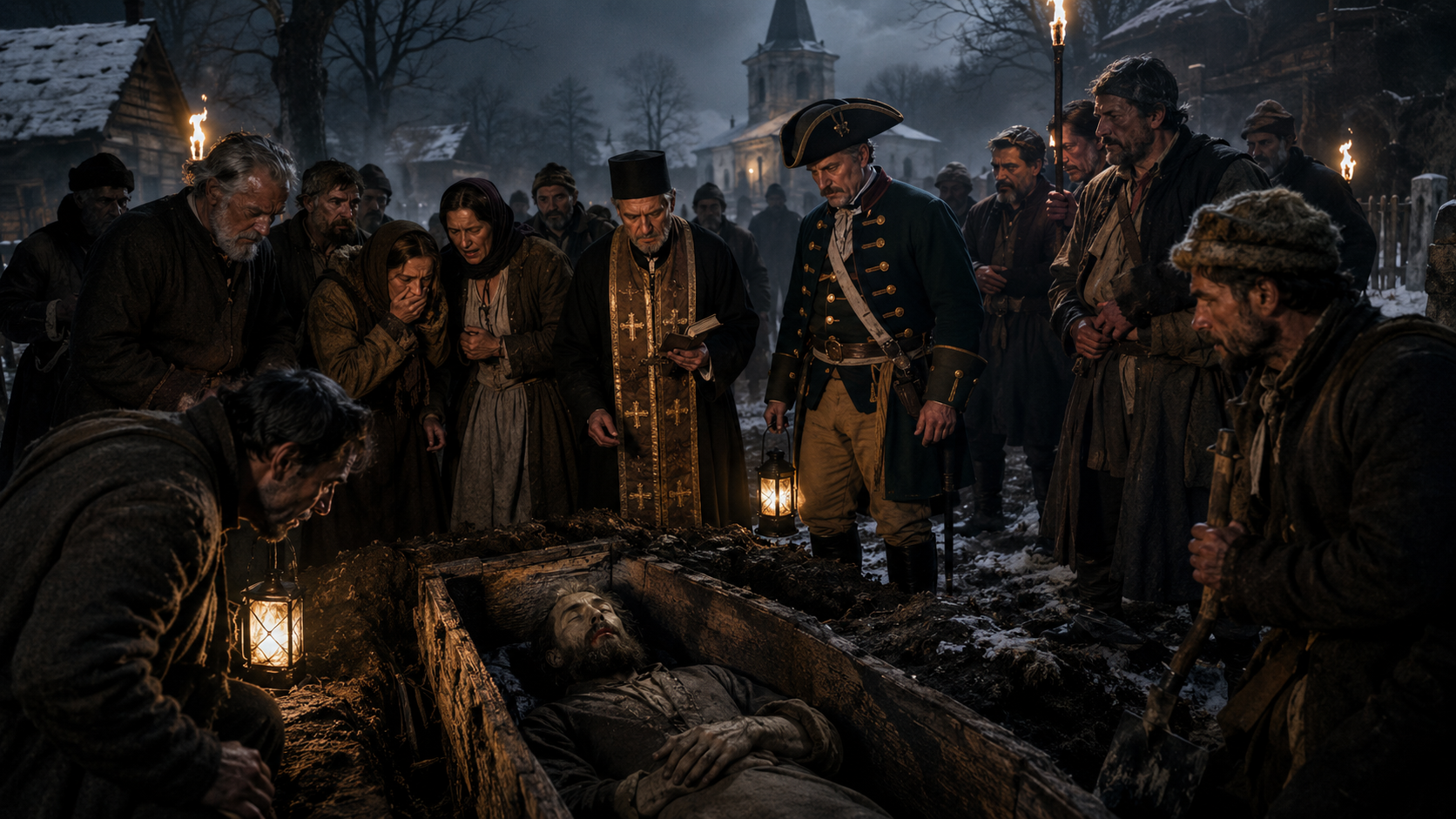
Buried alive. Exhumed by torchlight. Staked by trembling fingers.
These are not scenes taken from gothic or historical fiction, but documented facts from 18th century Europe, reported in popular newspapers, witnessed by terrorized communities, and drafted by imperial officials. The vampire folklore history of Eastern Europe is not a mere collection of superstition. Rather, it is a dark yet personal account of how regular people struggled to comprehend the reality of death in an age when death behaved differently.
So, what were these true stories of vampire panic in Europe, and why did an entire era fall victim to the horror of the undead so much that they started digging up their own dead? Why was the act of staking, burning, and beheading corpses performed not out of sheer brutality, but out of desperation?
Join me in stepping back into the misty villages of 17th and 18th century Eastern Europe where we will try to uncover the haunting truth of cold-blooded species.
The Haunting of Kisilova, 1725
A Death That Refused to Stay Dead
It was the winter of 1725 when the peaceful Serbian village of Kisilova was jolted by the sudden death of a local farmer, Peter Blagojević. The cause of death was unknown, which left everyone unsettled. However, the body was laid to rest, the prayers were said, and the villagers left the graveyard as night spread its dark shadows upon the village.
Nobody knew what disaster this sudden death might bring.
The Haunting Dreams
As the days moved on, the silent whispers started, which soon became louder.
Several villagers reported having dreams about the return of Peter Blagojević. Not as a gentle spirit or a fading memory, but as something purposeful and predaceous.
A villager recounted that he awoke in the middle of the night to see Peter standing at his bedside, with hands gripping his neck and pushing down with a cold, unnatural force. Another told of something more gruesome and brutal. He said Peter had suddenly appeared from the dark, bit deep into his flesh, and drank blood. He pulled aside his shirt to show the marks.
The entire village was enshrouded in dead silent. They were trying to digest the true scale of these events.
During this time, more villagers reported experiencing the same nightmares. First two, then four, and then nine people, all of whom were present at Peter’s funeral. All of them reported same nightly visitations. The same figure. The same violence. And then all of a sudden, these nine people began to fall ill, one by one.
Burials That Shook The Village
What followed was so gut-wrenching that it turned fear into panic.
All nine people who claimed to have been attacked by Peter during the night succumbed to death one after another. Nine deaths. Nine people. The very nine who participated in Peter’s burial.
The village was gripped by a sense of foreboding that no rational explanation could console. The villagers started packing up their stuff, preparing to flee. A group of elders, headed by the local parish priest, set out to meet Kameralprovisor Frombald, the Imperial Officer of the region. Their demand was unique. They wanted Peter Blagojević’s grave to be opened.
The villagers informed the officer that they were looking for the three major signs of vampirism, according to the deeply held folk belief.
- A body that had not decomposed
- Hair and nails that had continued to grow after death
- Fresh blood visible around the mouth
Frombald tried to resist. The graves must not be opened on account of rumours and hysterical dreams of the bereaved. But the villagers did not give up. They threatened to leave Kisilova forever if their demands were not met. To avoid the certain collapse of the entire settlement under his jurisdiction, the Imperial Officer finally gave in to the villagers’ demands.
The Grave Was Opened
Frombald made his way to the cemetery, together with the Parish Priest of Veliko Gardište. He was accompanied by some of the villagers. When the gravediggers’ shovels touched the wooden lid of the coffin and it was opened, the officer’s composure reportedly broke.
Peter Blagojević’s body had not yet decomposed.
His beard had grown. His nails had lengthened. And most chillingly, there was fresh blood at the corners of his mouth.
All three signs which the villagers had described were present. For Frombald who was trained in imperial administration and not superstition, the sight was apparently enough. His own account didn’t attempt to explain away from what he saw. As per the standards of the time, it was enough evidence to prove that Peter Blagojević had turned into a vampire.
The Village Verdict
What happened next had become a practice for centuries, rooted in the vampire folklore history of Eastern Europe. Villagers drove a stake into Peter’s chest, and fresh blood (a startling amount of it) gushed out of his ears and mouth. Shaken by the scene, they decided to leave nothing to chance. The body was then burnt to ashes.
The haunting was finally over.
Authenticity of the Peter Blagojević Case
It’s not an old campfire story or something that has been told for generations by frightened children.
The whole story about Peter Blagojević appeared in Wienerisches Diarium, the Viennese imperial newspaper, now known as Die Wiener Zeitung, one of the oldest newspapers in the world. This report was formal, detailed, and based on an eyewitness official account. The story is simple and straightforward with no sensationalism or ambiguity involved in the original published text. It’s one of the earliest and most thoroughly documented cases in the true stories of vampire panic in Europe.
Was Peter Blagojević Actually a Vampire?
Modern medicine and forensic scientists provide a different interpretation of these events.
The medical perspective suggests that Peter may have died from an infectious disease, one capable of being transmitted to others through physical contact. All nine people had participated in the burial of Peter, exposing them most to any pathogens present. In such scenarios, a cluster of deaths follows a primary fatality which is considered a known pattern in outbreak situations.
As far as the physical signs seen in his grave are concerned, modern forensic pathologists understand that decomposition is an unpredictable process, which can be slowed down by the coldness of the soil, and 1725 was a winter burial. Hair and nail growth following death has been established as an illusion created due to contraction and dryness of the skin. Blood-soaked lips are consistent with natural post-mortem processes in certain kinds of deaths.
But there are counter arguments to these explanations, which seem valid.
If Peter died of a viral disease that could spread through physical touch, then why hadn’t it transmitted to those who exhumed his body?
Why hadn’t the disease affected his family members, as no record of illness among his household has ever surfaced? If any such record existed, how could it have been left unattended, given that a Habsburg Imperial Officer conducted the inquiry and produced a report that was shared with higher authorities. The report contained no such evidence.
And then, what about the accounts of nine people themselves? Nine people who had seen the same intruder, experienced the same acts of violence, and felt the sensation of blood being drawn. Can we call it collective hallucination, an expression of shared grief, or mental trauma? Perhaps
Or perhaps there was something dark, mysterious, or more horrifying than the facts that surfaced.
History’s Open Wound
It’s impossible to declare with absolute certainty that Peter Blagojević was a vampire. It is also unclear whether he was responsible for nine deaths. However, we can say that an Imperial Officer of the Habsburg Empire witnessed the exhumation, and this incident shook him. A popular newspaper published the report. Nine people died in 8-9 days. And villagers felt the horror and did what terrified human beings have always done; they acted.
The vampire folklore history of Europe is not just about monsters. It is a history of human eras where death behaved differently, and where myths obscured the real facts. The true stories of vampire panic in Europe have survived not because they are mysteries, but because there is some part of the explanation still left unattended.
This is the first tale of our new series, Vampire Folklore History, True Stories of Vampire Panic in Europe. The next one is even more soul-tingling; it’s a story that was investigated by the governments of several European countries. It is well documented, and yes, it is even stranger than what you’ve read today.
If you don’t want to miss out, subscribe to my newsletter below. It will keep you updated about my upcoming hauntingly immersive short stories.