
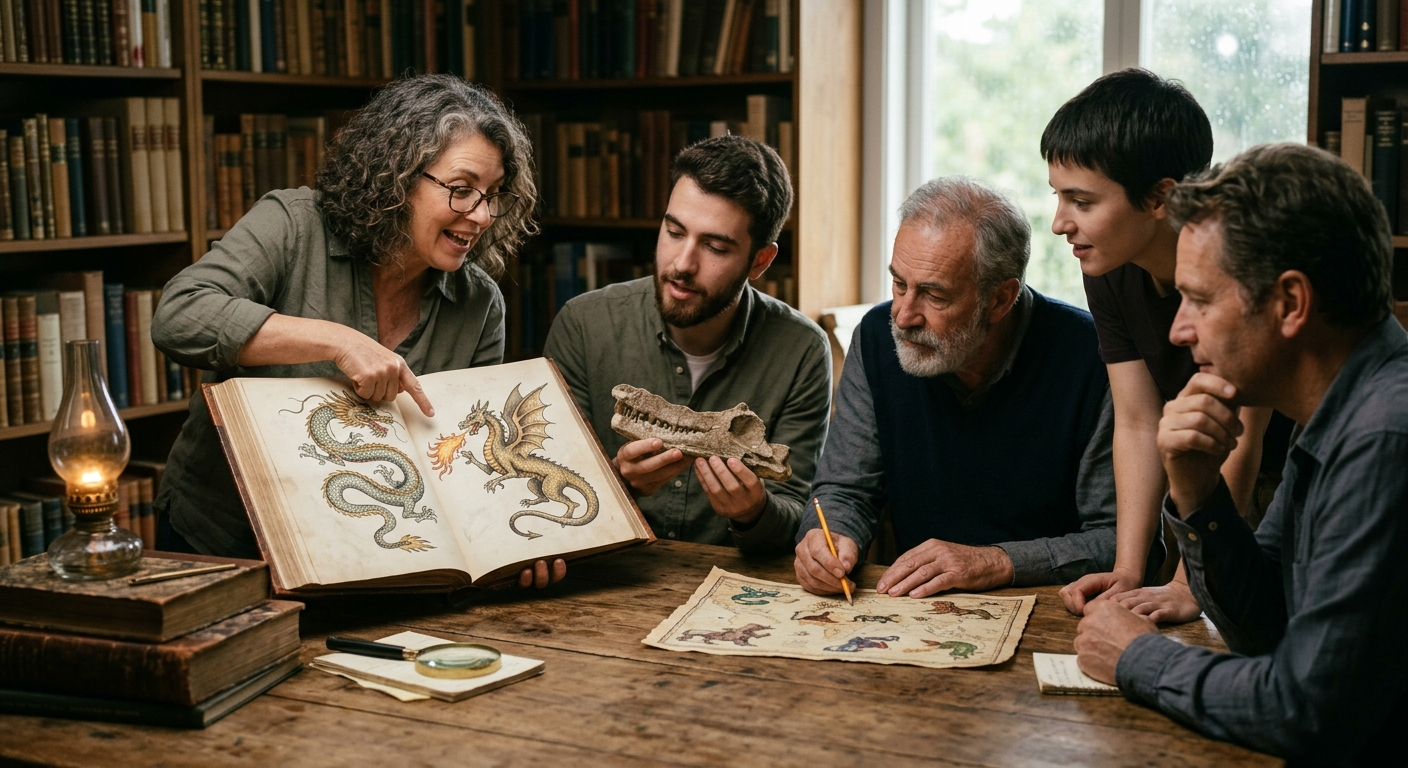
Humans love stories about giant beasts. Among all the monsters we imagine, dragons are the most famous. You can find them in old stories from every corner of our planet. They fly through the cold skies of Europe and swim through the deep rivers of Asia. They crawl in the legends of the Americas and hide in the tales of Africa.
Why do dragons appear in so many cultures? This is a mystery that has puzzled researchers for many years. Did we all copy the same story? Or did we dream up these scaled monsters on our own?
We will look at the history of dragon mythology. We will explore how different cultures created these famous beasts. By looking at science, history, and the way our brains work, we can finally understand why these monsters are everywhere.
If you want to read more amazing mysteries or purchase captivating books, check out the epic stories at S. F. Shaw.
What Is the Oldest Known Dragon Myth and Which Civilization First Believed in Dragons?
To find the first dragon, we must travel back in time. We need to look at ancient civilizations and dragons. Our journey starts in Ancient Mesopotamia. This is where human writing first began.
People in Babylon wrote some of the earliest stories on clay tablets. They believed in a massive cosmic serpent named Tiamat. She was a giant sea monster who represented primordial chaos. Another famous beast from this area was Mušḫuššu. This creature had the legs of an eagle, the tail of a scorpion, and the scales of a snake.
Around the same time, Ancient Egypt had its own fearsome serpent. They called this beast Apep. He was a giant snake of darkness who tried to eat the sun god every night.
So, what is the oldest known dragon myth? Most historians agree that the oldest stories come from these ancient cities. Mesopotamian dragon mythology is the true starting point. These early stories show that the history of dragon mythology is as old as human writing itself.
Did Europe and China Invent Dragons Independently or Did Trade Routes Spread Dragon Legends?
How did these stories travel so far? Did Europe and China invent dragons independently? Or did some ancient travelers share their scary campfire stories along the road?
The answer is a mix of both. Some cultures definitely created their own monsters. Yet, trade routes played a massive role in sharing these ideas. The Silk Road was a huge network of trails that connected Asia to Europe. Merchants did not just carry silk and spices. They also carried their beliefs and legends.
As people met, they shared their local folklore. This created a rich cultural exchange. This myth transmission happened over thousands of years. It was a slow process of oral tradition.
Some researchers study comparative mythology to see how stories change. They look at human migration patterns. Many think that some stories have a shared ancestry. Perhaps the earliest humans carried a basic serpent story with them when they walked out of Africa. As they moved, they adapted the story to fit their new homes. This mix of cultural diffusion and independent invention explains why we see these beasts everywhere.
I remember when I was a kid and my grandmother told me a story about a hidden dragon under our cellar steps. It made me realize how easily a simple story can make us look at the dark with a sense of wonder.
Chinese Dragons vs Western Dragons: Why Are They So Different?
If you look at Eastern dragons vs Western dragons, you will see two totally different beasts. They look different and they act different.
The differences between Eastern and Western dragons are very clear. Asian and European dragon differences start with how they look. A Chinese dragon is often called a Chinese loong or simply a Long. It looks like a long snake. It has the scales of a fish, the horns of a deer, and the claws of an eagle. These beasts do not usually have wings. Yet, they can still fly through the air using magic.
In Chinese mythology, these creatures are benevolent. They represent good fortune, rain, and water. People believed the Dragon Kings ruled the oceans and controlled the weather.
On the other hand, European dragon mythology shows a very different beast. A Western dragon is a heavy reptile with huge bat wings. It has sharp horns and a thick tail. It breathes fire and lives in dark caves.
European dragon symbolism is almost always negative. They represent greed, danger, and destruction. They hoard gold and capture princesses.
Why are Chinese and European cultures both have dragons if they are so different? Why are Chinese dragons different from European dragons? It is because each culture used the beast to explain different things. China saw the dragon as a friendly water deity. Europe saw it as a terrifying force of nature.
Were Dragons Inspired by Dinosaur Fossils or Did Ancient People Find Dinosaur Bones?
Imagine digging in a field thousands of years ago. Suddenly, you hit a massive bone. It is bigger than any animal you have ever seen. What would you think it was?
This is why many people ask did dinosaur fossils inspire dragons. The answer is highly likely. Did ancient people find dinosaur bones? Yes, they absolutely did.
Ancient civilizations did not have modern science. They had no idea what a dinosaur was. When they found paleontological remains, they had to make sense of them. A giant skull with sharp teeth looked like a monster.
This is a classic case of fossil interpretation. In ancient China, people actually called these discoveries dragon bones. They even ground them up for medicine. In Europe, finding a giant woolly rhino skull led to legends of fearsome monsters.
The link between dragon myths and dinosaur fossils is very strong. These fossils mistaken for dragons helped people believe that the old stories were real. It gave them physical proof of the monsters.
I once went to a museum and stood next to a massive fossil and felt a sudden chill. It is easy to see how an ancient farmer would run home in absolute terror after finding one of those in the dirt.
Were Ancient Dragons Based on Real Animals like Snakes or Crocodiles?
Fossils are not the only real animals behind dragon legends. Were ancient dragons based on real animals? Many researchers think so.
What inspired dragon myths? Ancient people lived very close to wild nature. They encountered dangerous creatures every day.
Were dragons inspired by snakes? Yes, this is very common. Snakes move in a quiet, spooky way. Their venom can kill a human in minutes. This natural fear made the snake a perfect model for a monster.
Were dragons based on crocodiles? This is also highly likely. A crocodile is a giant reptile with thick scales and sharp teeth. If you see a crocodile swimming in a murky river, it looks just like a water dragon.
Were dragons based on giant reptiles like the Komodo dragon? People in ancient times did travel to distant islands. They brought back wild stories of giant lizards that could eat a goat. Over time, these stories grew bigger and wilder. The real animals faded into myth, and the supernatural dragon took their place. This shows how our ancestors took real dangers and turned them into legendary monsters.
Why Are Dragons Found Worldwide and Do All Cultures Actually Have Dragons?
It seems like every country has its own monster. Why are dragons found worldwide? Why are dragons common in mythology?
The truth is that global dragon myths are not all exactly the same. Do all cultures actually have dragons? Not in the way we think. Many cultures have giant serpent myths instead of winged, fire-breathing monsters.
Yet, why do dragons appear everywhere? Why are giant serpent myths common? Why are serpent myths universal?
Some historians call this convergent mythology. This means different cultures came up with similar ideas on their own because they had similar experiences. They all saw snakes, birds, and big cats. They all faced storms and floods.
Why do unrelated cultures have dragons? Why are dragons similar across cultures? Why do civilizations have similar myths? It is because humans share the same fears and the same basic brain. We all wanted to explain the scary, unexplained things in our world.
Whether it is dragon folklore around the world, dragon stories from different cultures, or dragon traditions around the world, these beasts help us tell stories about danger and survival. They are a way to make sense of a wild and chaotic world.
Are Dragons Universal Human Archetypes?
Why do humans imagine dragons? Why are humans fascinated by dragons? Why did people believe dragons were real? To answer this, we must look inside our own minds.
Some scientists study evolutionary psychology to find the psychological origin of dragons. They believe our brains still carry ancient memories from our primate ancestors.
Millions of years ago, early humans faced three main predators. These were snakes, birds of prey, and large cats. A scientist named David E. Jones created the predator-detection hypothesis. He argued that the dragon is a hybrid creature. It combines the scales of a snake, the wings of an eagle, and the teeth of a leopard.
When we combine these three primal fears, we get the ultimate monster. This is the primal fear theory dragons. Our human fear of snakes mythology is deeply wired into our nervous system.
Are dragons universal human archetypes? Yes, they are. Carl Jung, a famous psychologist, said that some symbols are part of our collective memory. The dragon archetype meaning is connected to our deepest instincts. It represents the ultimate danger we must face to grow strong.
Could Natural Disasters and Geomythology Have Inspired Dragon Myths?
Sometimes, the earth itself seems to scream. Volcanoes explode with hot lava. Earthquakes shake the ground. Floods wipe out entire villages.
How did ancient people explain these terrifying events? They used stories. This field of study is called geomythology of dragons.
What natural events inspired dragon stories? Natural disasters and dragon myths go hand in hand. If a volcano erupts, it looks like a giant fire-breathing beast waking up inside the mountain. Volcanoes and dragon legends are very common in places with active earth movement.
Storms and dragon mythology are also deeply connected. Lightning looks like a golden snake flashing across the dark sky. Thunder sounds like the roar of a giant monster.
Dragons and weather mythology often show these beasts as forces of nature. They are rain-bringing creatures or creators of terrible floods. In many cultures, dragons and flood myths go together. The dragon is a water deity that can either give life with rain or destroy everything with a massive storm. This environmental symbolism made the dragon a perfect metaphor for the untamable power of our planet.
To discover more wonderful worlds and modern tales of wonder, visit the website of S. F. Shaw.
Why Do Dragons Guard Treasure and Why Do Western Dragons Breathe Fire?
In many Western stories, the dragon sits on a pile of gold inside a dark cave. Why do dragons guard treasure in mythology?
This idea comes from ancient Germanic folklore and Norse mythology. A famous example is Fafnir. He was a man who became a greedy monster because of his love for gold. He crawled into a cave to guard his treasure. This story shows how dragons represent greed and evil.
The Beowulf dragon is another classic treasure-hoarding beast. This monster lives in a stone barrow and attacks when someone steals a gold cup.
Why do Western dragons breathe fire? Fire is a symbol of absolute destruction. It represents the hot anger of the beast. It also links back to the fires of hell in Christian stories.
Why do heroes fight serpents in ancient myths? This is the classic storm-god myth of chaoskampf. A brave hero or a storm god must fight a serpentine monster to restore order to the world. The fight represents the struggle between good and evil, order and chaos. The dragon is the ultimate test for any hero.
What Do Dragons Symbolize in Different Cultures?
What do dragons symbolize? The cultural meaning of dragons changes depending on where you look. The spiritual meaning of dragons is full of double meanings.
In some places, dragons are symbols of power and symbols of wisdom. They represent imperial power, good fortune, and fertility. This is especially true in Chinese mythology. Emperors used the dragon as a symbol of royalty and authority.
In other places, dragons are symbols of chaos and symbols of protection. They guard sacred places or hold up the entire world.
How did Christianity change dragon mythology? In early European stories, dragons were dangerous but sometimes wise. Yet, medieval European stories changed this. Christianity portrayed dragons as symbols of evil and Satan. They became the ultimate enemy of saints. The famous story of St. George’s dragon shows a brave knight saving a town from a terrible marsh beast.
Let us look at some of the different traditions around the world.
Asian Dragon Mythology
In Asia, these beasts are mostly good. Japanese ryū and Korean yong are connected to water and agriculture. They bring rain and guard rivers. They do not breathe fire and are highly respected.
European Dragon Mythology
In Europe, dragons are fearsome enemies. They live in deep caves or dark forests. Knights must hunt them down to prove their bravery.
Mesoamerican Dragon Mythology
In Central America, the Aztec mythology and Maya mythology feature a feathered serpent named Quetzalcoatl. He was a creator god associated with the wind and learning.
African Dragon Mythology
African folklore has many serpent monsters. One of the most famous is the Rainbow Serpent in Indigenous Australian traditions, which shares many traits with African water beasts. These creatures represent water, life, and the cycles of nature.
The Ultimate Seven Theories Explaining Global Dragon Myths
Why do we see these monsters everywhere? Here are seven theories explaining global dragon myths that help us make sense of this mystery.
1. The Fossil Theory
Ancient people found dinosaur bones and thought they belonged to giant monsters. This paleontological remains theory is very popular.
2. The Predator Fear Theory
Our brains are wired to fear snakes, big birds, and wild cats. The dragon is a hybrid creature that combines all three.
3. The Geomythology Theory
People used stories of giant beasts to explain natural disasters like volcanoes, floods, and storms.
4. The Real Reptile Theory
Encounters with real crocodiles, massive pythons, and giant lizards inspired the legends.
5. The Shared Ancestry Theory
The stories started with our early ancestors in Africa and spread as humans migrated across the globe.
6. The Cultural Diffusion Theory
Stories traveled along trade routes like the Silk Road, changing as people shared them.
7. The Cognitive Archetype Theory
The dragon is a deep psychological symbol of chaos that exists in all human minds.
Famous Mythological Dragons Across the Globe
Every culture has its own famous beast. Let us look at some of the most famous dragons in mythology.
Tiamat and Mušḫuššu
These ancient Mesopotamian beasts from Babylon represent the primordial chaos of the salt sea.
Apep
The giant Egyptian serpent of darkness who fought the sun god Ra every night.
Leviathan
A giant sea monster mentioned in ancient Hebrew texts.
Jörmungandr
The Norse cosmic serpent that wraps around the entire world.
Quetzalcoatl
The beautiful feathered serpent god of Mesoamerica.
Bakunawa
A giant sea serpent in Philippine mythology that eats the moon.
The Lasting Legacy of World Dragon Mythology
How dragon mythology changed over time shows us how human culture grows. We started with simple fears of snakes in the grass. We turned those fears into giant, fire-breathing monsters.
Whether they are symbols of wisdom or symbols of evil, dragons still capture our imagination. They remind us of the mystery of the unknown. They show us that we all share the same human stories, no matter where we live.
FAQs
Why do dragons appear in so many cultures?
Dragons appear in many cultures because humans share the same basic fears of predators like snakes.
Do all cultures actually have dragons?
Not all cultures have the classic winged, fire-breathing dragon. Many ancient cultures had stories of giant serpents or hybrid water beasts instead.
Did dragon myths arise independently?
Yes, many arose on their own. Yet, travelers also shared their local legends along trade routes, which helped spread the stories.
What is the oldest known dragon myth?
The oldest stories come from Ancient Mesopotamia and Ancient Egypt, featuring giant snakes and sea monsters like Tiamat and Apep.
Were dragons inspired by dinosaur fossils?
Yes, finding giant bones in the dirt led many ancient people to believe that giant monsters once walked the earth.
Were dragons based on snakes or crocodiles?
Many legends were inspired by real encounters with large pythons, crocodiles, and giant lizards.
Why do dragons usually look like reptiles?
Reptiles like snakes have always triggered a natural fear in humans, making them the perfect model for a scary monster.
Why do dragons guard treasure?
This idea became popular in European folklore, where the dragon became a symbol of greed and hoarded wealth.