
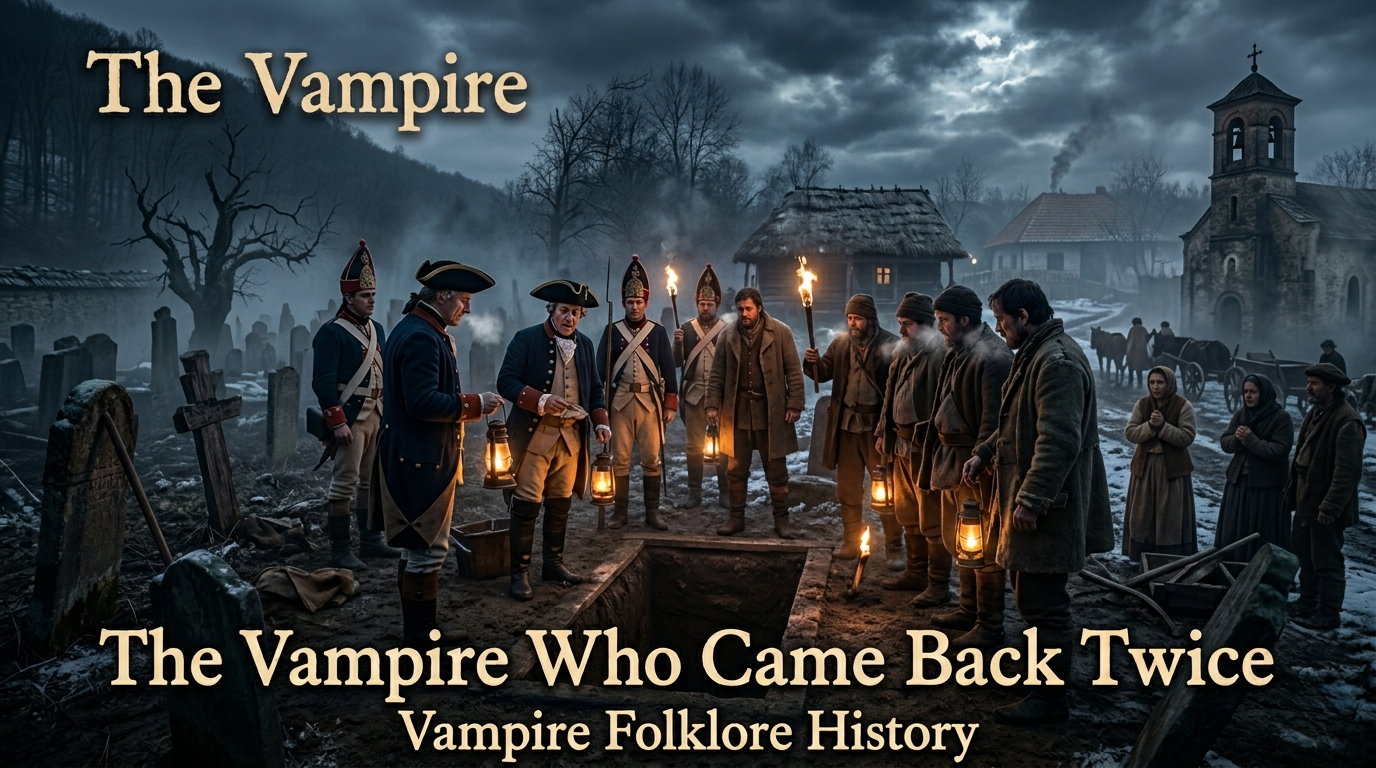
A man who was bitten by a vampire. The soldier who thought he had broken the curse. A village that lost 16 people for his past. A new chapter of vampire folklore history.
The story of Arnold Paole is not a piece of mythical narrative taken from Dracula, Vampire Diaries, or Twilight Saga. It’s one of the most thoroughly researched, well-documented, and widely circulated cases in vampire folklore history. Multiple military surgeons signed their names; imperial officers bore witness to the events and produced a report that reached the war councils of Vienna and was republished across Western Europe. Surprisingly, the detail of these events remains as unsettling today as they were in 1732.
A Soldier with a Dark Secret
Arnold Paole, a hajduk (an irregular soldier) who lived in the village of Medveda, located near the West Morava River, in the Trstenik region of Serbia. This territory came under the control of the Habsburg following the Treaty of Passarowitz in 1718. It placed this village under the direct Austrian military administration.
According to the accounts of Medveđa residents, as told later by the military doctor Johann Flückinger, Paole was not a man of quiet disposition. By all accounts, he was a tormented man. The residents recalled how Paole would often speak of being plagued by a vampire in a place called Gossowa (possibly Kosovo), where he served as a soldier under Ottoman rule. However, these are not documented facts but were told by common people. The stories also explain that Paole, when plagued, found a cure. The cure was to eat the dirt from the vampire’s grave and cover himself with its blood.
We can’t say whether these confessions were genuine beliefs or superstitions. What is documented is what comes next.
The First Death, The First Wave
These rumours circulated across the territories about how Paole was bitten by a vampire and how he got a cure. People were digesting these stories when suddenly Arnold Paole died in 1725. It’s important to know that he didn’t die from a mysterious illness or nocturnal attack, but from an accident. According to the reports, he broke his neck falling from a haywagon. The speculations died slowly when Arnold was buried in the village cemetery, and life in Medveda returned to normal.
But this normality didn’t last long, as four villagers complained that they had been plagued by Arnold within twenty to thirty days of his burial. These complaints were similar to what we saw in Kisilova the same year. Nightmares, a sense of being strangled or gripped, an oppressive presence. The horror and panic returned to the village when all four people died within days. Villagers started speculating that the four people were tormented and killed by Arnold.
After forty days of Arnold’s burial and the four people’s death, villagers realized that uneasiness had grown to a level of suffocation. Their last-ditch effort was to convince local military-administrative figures to intervene and investigate this matter. In the presence of these official personnel, they opened Paole’s grave after forty days. What they found, according to Flückinger’s report, was startling.
- The body showed no signs of decomposition
- The report said that Paole’s veins were full of blood.
- Fresh blood had flowed from his eyes, nose, mouth, and ears.
- His nails had fallen away, and new ones had grown in their place.
- Paole’s body appeared red, and his hair and beard had continued to grow.
These were the signs of vampirism, according to the prevailing beliefs in Eastern Europe. The villagers drove a stake through his heart. The report also said the corpse let out a groan and bled. It further horrified the locals, who then decapitated the body and burnt the remains. Not only this, but they also exhumed the bodies of the four who died after him and gave them the same treatment.
It is important to clarify that the initial complaints about Paole to the exhumation and subsequent staking of the body were not directly observed by the Austrian authorities. It is known through the villagers’ own account, as retold years later in Flückinger’s 1732 report. In contrast, the case of Peter Blagojević, which took place in the same year, was confirmed by the imperial document.
The Return of Vampire Horror After Five Years
After this event, Medveda remained peaceful and quiet for five years.
Then, in the winter of 1731, the horror revived; people began dying again.
The death toll rose rapidly, creating an atmosphere of terror and chaos. The villagers reported the same pattern. Nighttime visitation, chest pain, sudden illness, and rapid health deterioration. A few of them died within two to three days; others lasted weeks. By mid-December 1731, thirteen people had died in six weeks. By early January 1732, the death toll increased to seventeen according to Flückinger’s report. Seeing this, the Austrian military took formal notice.
The Official Investigations
The villagers complained to Oberstleutnant Schnezzer, the Austrian military commander. Alarmed by the rising number of sudden deaths, he sent Imperial Contagions-Medicus Glaser, essentially an infectious disease expert, from the nearby town of Paraćin to investigate the second case of vampire panic in Europe.
On December 12, 1731, Glaser examined the villagers and their homes. His first thought was rational and calculated; he found no signs of contagious disease. Instead, he figured the people died from malnutrition and the intense stress of severe fasting tied to their religion. But when the people threatened to leave the village if something wasn’t done about the suspected vampire problem, Glaser agreed to dig up a few recent graves.
What he found unsettled him. Most of the bodies were not decomposed. Several were visibly swollen and had blood at their mouths. Only the most recently deceased showed the kind of decomposition he expected. Glaser documented his findings and forwarded them to the Jagodina commandant, recommending that authorities pacify the population by fulfilling their request. The report was escalated to the Supreme Command in Belgrade.
A second, formal team was formed. Led by military surgeon Johann Flückinger, it included Lieutenant Colonel Büttner and J. H. von Lindenfels, as well as surgeons Siegele and Baumgarten. On 7 January 1732, they joined village elders and local Romani gravediggers to exhume the bodies.
Their findings defied easy explanation. Five bodies decomposed normally, but the other twelve didn’t decay at all. Their organs were in good shape, and their chests had fresh, uncoagulated blood. Some looked plump with rosy, vibrant skin. Plus, in several cases, old nails fell off, revealing new ones underneath. The surgeons labelled these bodies as being in a state of what they called Vampyrenstand, i.e., a vampiric condition.
The report was signed by all five officers on January 26, 1732, in Belgrade, and it was shared with Vienna’s Imperial Council of War. This report was also reprinted widely across Europe, which contributed to the great 18th-century vampire debate. This discussion kept intellectuals, physicians, and clergy occupied for decades.
Connecting the Second Wave to the First
Flückinger’s report tries to explain how vampirism came back five years after Paole’s grave was handled. The villagers gave two explanations, which he wrote down even though he noticed their folklore nature.
First, there was Milica, the initial victim during the 1731 outbreak. Locals said she had eaten meat from sheep that Paole’s victims had killed years ago. Then there was Stana, a young woman who admitted before death that she smeared herself in vampire blood for protection while in Ottoman territory. These stories were based on a folk belief. It was thought that coming into contact with or ingesting something touched by a vampire would eventually turn you into one.
However, you need to know that these are not conclusions reached by the Austrian medical commission.
A Critical Analysis
It is undoubtedly true that Arnold Paole’s case has many similarities with Peter Blagojević’s case, which preceded it by a year. A primary death, a cluster of subsequent deaths, victims’ testimony of nighttime visitations, and physical findings at the time of exhumation defied the expectations of those present. In both cases, villagers threatened to abandon their homes. Officials from the Habsburg government stepped in. The reports also confirmed the existence of vampirism, at least in their language. This was enough to ignite the flames of vampire panic in Europe.
However, medical professionals were also involved in investigating the second wave in Medveda, making it a more formally documented case than the first. But the scientific explanations remained the same as what we saw during Peter Blagojević’s case. Modern-day forensic pathologists believe that bodies decompose slowly in cold winter soil. As the body breaks down, gases build up, pushing blood towards the mouth and nose. When skin shrinks, it can make hair and nails look like they’re growing. These are well-established phenomena in forensic pathology today.
The reason the Arnold Paole case is hard to dismiss is that it’s hard to explain. The scale was large, with a minimum of sixteen deaths over two waves, spanning five years in the same village. Additionally, the documentation was solid, including two medical reports, an escalating chain of imperial command, and five signatures on a formal commission finding. Then, the story covered more ground, spreading across Western Europe within a few weeks of being written.
And then there is the echo of the first case. Paole himself reportedly feared vampires before he died. His pre-death confession, even if taken only as village testimony, suggests a man who believed he had been contaminated by something. Whether that belief was rooted in a real epidemic he had witnessed, a psychological break, or something else entirely, it preceded and, in the villagers’ minds, explained everything that followed.
Mysteries Yet Unsolved by Modern Science
Although modern forensic pathology rejects the claims of vampirism as nothing more than a result of slow decomposition in the cold weather, one question remains unanswered: if both waves were caused by infectious disease, what interrupted them for five years? Contagions don’t wait for half a decade in the same village and then resume.
Moreover, in both cases, the deaths stopped immediately after the exhumations were carried out, a fact that had been documented precisely. Why did the deaths cease only after the grave-digging event?
If an infectious disease was responsible, why was it not transmitted to those who took part in their burials? They literally exhumed the bodies, staked them, pierced their chest and removed their hearts. It is therefore difficult to understand why the infection didn’t spread to those people.
The Case That Set a New Chapter in Vampire Folklore History
The Flückinger report achieved what the Peter Blagojević case couldn’t: it brought vampire panic to the desk of European intellectuals. Voltaire wrote about it sardonically, theologians debated it, and physicians published responses. Even the Holy Roman Emperor stepped in, ordering that vampire exhumations required official medical supervision.
The Arnold Paole case didn’t just terrorize a village. It made the educated class of 18th-century Europe face something which they could neither accept nor dismiss.
This is the second story in the Vampire Folklore History – True Stories of Vampire Panic in Europe series. The next event is even more unbelievable, unveiling mysteries that the living have never quite managed to explain effectively.
Subscribe to my newsletter below so you don’t miss it.